It is important to know what goes into the apps that you and your children use everyday. The algorithms and designs that go into mobile applications are often unexplained to the average user. Various unexplained parts of apps can include how content is chosen to be shown to the user, how endlessly scrolling works, and how free mobile games make their money. Not all practices in the industry are predatory or harmful, but there may be a few that you should look out for. When interacting with a new app, a person who does not have an extensive background in software design should be able to recognize certain practices or algorithms in order to make the best decision going forward in using said app. Our goal is to showcase the data and statistics on phone usage, as well as the design elements that are potential risks to you and your family.
There are various design elements in applications that are very common in the industry. Perhaps the most popular concept is known as 'infinite scrolling'. According to the Interaction Design Foundation, infinite scrolling is defined as "an interaction design pattern in which a page loads content as the user scrolls down, allowing the user to explore a large amount of content with no distinct end"
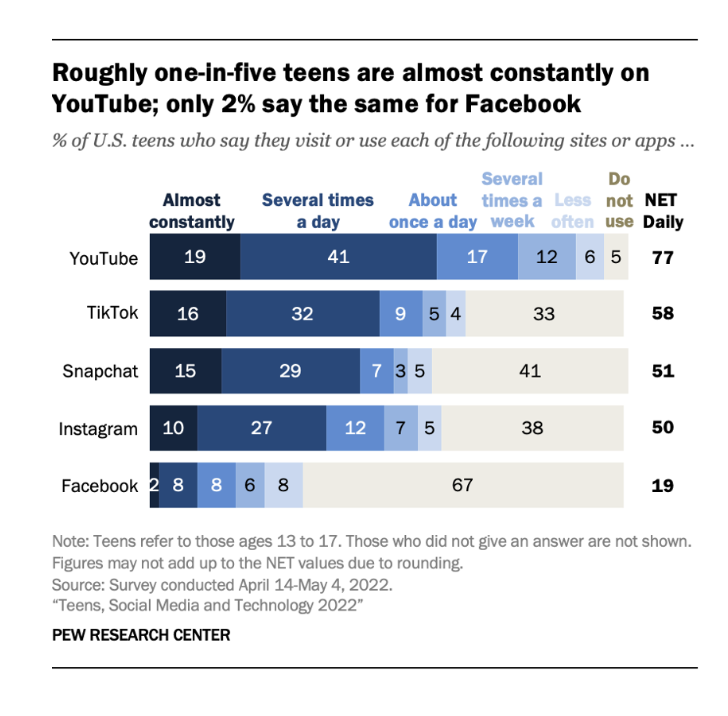
They state that while infinite scrolling increases time spent on sites, it is also responsible for creating addictive experiences. After public outcry on the addictive design practices of social media applications, Instagram and YouTube have implemented settings to limit users' time on the application.
It is important to understand the possible downsides of infinite scrolling in the context of daily phone usage. The ability to scroll endlessly creates an environment for the user that constantly feeds them new content and new stimuli. A social media app turns into an easy source of dopamine for the user---a source that never runs out. As you could guess, this can be detrimental to your mental health and to the mental development of your children. Whenever you or your child logs onto social media, it is important to be conscious of how long you are going to spend on the app.
In an article by Bruce Goldman from Standford, Anna Lembke states that social connection has become druggified by social-media apps, making us vulnerable to compulsive overconsumption. These apps can cause the release of large amounts of dopamine into our brains' reward pathway all at once, just like heroin, or meth, or alcohol. They do that by amplifying the feel-good properties that attract humans to each other in the first place. Then there's novelty. Dopamine is triggered by our brain's search-and-explore functions, telling us, "Hey, pay attention to this, something new has come along." Add to that the artificial intelligence algorithms that learn what we've liked before and suggest new things that are similar but not exactly the same, and we're off and running.
Considering everything, what are you able to do about this? There are a few strategies to mitigate device overuse. It is important to note that while mobile devices are not necessarily the problem, but rather the applications. It is typical for smartphone users to lose track of time and endlessly scroll when they have free time. One feature that you are able to utilize is called 'app limits' or 'app timers'. Most smartphones today are equipped with an app or tab in settings that measures the total amount of time spent on certain apps. Users are then able to which select apps they want to have a time limit for. For the average person, we recommend to limit social media apps to about 20 to 30 minutes a day. This allows users to limit themselves to the amount of content they expose themselves to on a given day.
According to Christian Montag et al., Excessive use of smartphones is known to impact on social communication in terms of reducing smiles when interacting with strangers, enjoyment of face-to-face interaction or drawing parent's attention away from their children. This might result in a loss of empathy, although so far only correlations between excessive Internet use and lower empathy/social skills could be established, with only weak associations between excessive smartphone usage and empathy.
Another strategy we recommend, would be making sure to engage in social activities that are not found on your mobile devices. It is important that your children and teenagers interact with their peers and trusted adults on a more face-to-face level everyday in order to ensure adequate social development. You can enroll them in sports, have them take music lessons, or have them sign up for clubs and other extracurricular activities. The end goal is for them to get the majority of their social interaction from real life situations. This is important for the development for their social skills and sense of empathy. If they are able to obtain most of their socializing on a face-to-face level, the negative effects of social media on their social development will be mitigated.
Data and visuals from the Pew Research Center. Image Source: Emily A. Vogels and Risa Gelles-Watnick, 2023. Accessed via the Pew Research Center website